

The Guava Problem
Why the Note Everyone Calls "Generic Tropical" Is One of the Hardest to Build


Most tropical briefs that land in my inbox are not actually tropical briefs. They are mango briefs, or passionfruit briefs, or “make it taste like a beach vacation” briefs. And buried in a lot of them is one word that quietly causes more reformulation rounds than any other fruit in the category.
Guava.
Here is what usually happens. A brand asks for guava, gets back a mango and pineapple blend tinted pink, tastes it, and says “close, but it’s missing something.” They are right. It is missing something. The problem is that the “missing something” is not another fruit – it is a sulfur compound shared with passionfruit and Sauvignon blanc, a green note that does not exist in the intact fruit, and a balsamic facet that guava inherited from its botanical family, which is closer to clove than to mango.
Guava reads as “generic tropical” to most people. Chemically, it is one of the least generic fruits in the category. That gap between perception and chemistry is exactly why it is hard to build.
This edition breaks down what actually makes guava smell like guava, why it sits apart from every other tropical note, and how to construct it. The free section covers the botany, the sensory architecture, and the myths. Paid subscribers get the full compound breakdown, the thiol dosing math, and a formulation framework you can build onto a tropical accord.
Guava Is Not Really a Tropical Fruit (Botanically Speaking)
Let’s start with where guava comes from, because it explains the chemistry.
Guava (Psidium guajava) belongs to the Myrtaceae family. Its relatives are not the other tropical fruits you would expect; they are clove (Syzygium aromaticum), allspice (Pimenta dioica), eucalyptus, feijoa, bay rum, and myrtle. This is the spice and essential-oil family. Every member is woody, aromatic, and loaded with terpenes and phenylpropanoids.
That heritage shows up in the fruit. Guava has a woody, slightly peppery, balsamic edge that mango, pineapple, and passionfruit simply do not have. The leaves and skin are rich in beta-caryophyllene and other sesquiterpenes, the same compound class that gives clove its backbone. The fruit’s perfumey, almost cinnamon-adjacent quality, comes from cinnamate esters, which are phenylpropanoids, the same biosynthetic territory that produces eugenol in its cousin the clove.
So when a guava flavor reads as “more interesting” or “more complex” than a generic tropical blend, that is not marketing language. It is the fruit showing a real spice-family signature on top of its fruit chemistry.
Pink versus white. The two common types are not just a color difference. Pink guava (lycopene-pigmented flesh) is sweeter, lower in acid, and more aromatic, with a stronger sulfur-driven tropical character. White guava is more tart, greener, and leans harder on the fresh-cut aldehydes.
Most of the rigorous aroma chemistry (and the framework in this piece) is built on pink guava, because pink is what most “guava flavor” briefs are actually targeting. If a client wants a fresh, green, slightly astringent guava, you are building toward white, and the green-aldehyde layer moves forward while the jammy furanones pull back.
The Sensory Signature: Four Layers, Not One
Guava is not a single note, but a layered composition of four distinct facets that must exist in balance. The challenge is that two of those layers naturally compete against the other two, and even slight shifts in proportion can disrupt the profile entirely.
1. The green, crushed-leaf top. The first thing you register from a fresh-cut guava is green. Not citrus-green, not herbal-green. Crushed-leaf green, with a slightly vegetal, almost cucumber edge. This is the layer that signals “fresh fruit, just opened.” It is also the most fragile layer, for a reason I will explore further in the paid subscriber section.
2. The sulfury-tropical core. Under the green sits the part that makes guava smell exotic rather than generic. It is sulfurous in the best sense: grapefruit, passionfruit, blackcurrant, a faint catty quality at the edges. This is the layer most people cannot name but immediately miss when it is absent. It is also the layer that a mango-pineapple blend has no way to produce.
3. The balsamic, perfumey mid. This is the spice-family signature. Warm, slightly cinnamon-like, balsamic, a little floral. It is what gives guava its “cologne” quality, the sense that the fruit is wearing something. It bridges the sharp top and the sweet base.
4. The jammy, caramel base. Guava finishes sweet and cooked, with a strawberry-jam and caramelized quality. This is the layer that makes guava nectar and guava paste taste the way they do, and it is why guava pairs so naturally with dairy and with baked applications.
Build only the top and core and you get something that smells like tropical fruit but does not resolve. Build only the mid and base and you get guava paste, cooked and flat, with no life. The fruit is the tension between fresh-green-sulfury on top and balsamic-jammy underneath. Hold that tension and you get guava. Lose it and it comes off as “tropical, generic, pink.”
Why Guava Is Not Mango, Pineapple, or Passionfruit
The fastest way to understand guava is to put it next to the three fruits it gets blended with and mistaken for: mango, pineapple, and passionfruit. Each of those three is driven by a different chemical class. Guava is unusual because it draws from all of them simultaneously, while also containing a defining chemical character entirely its own.
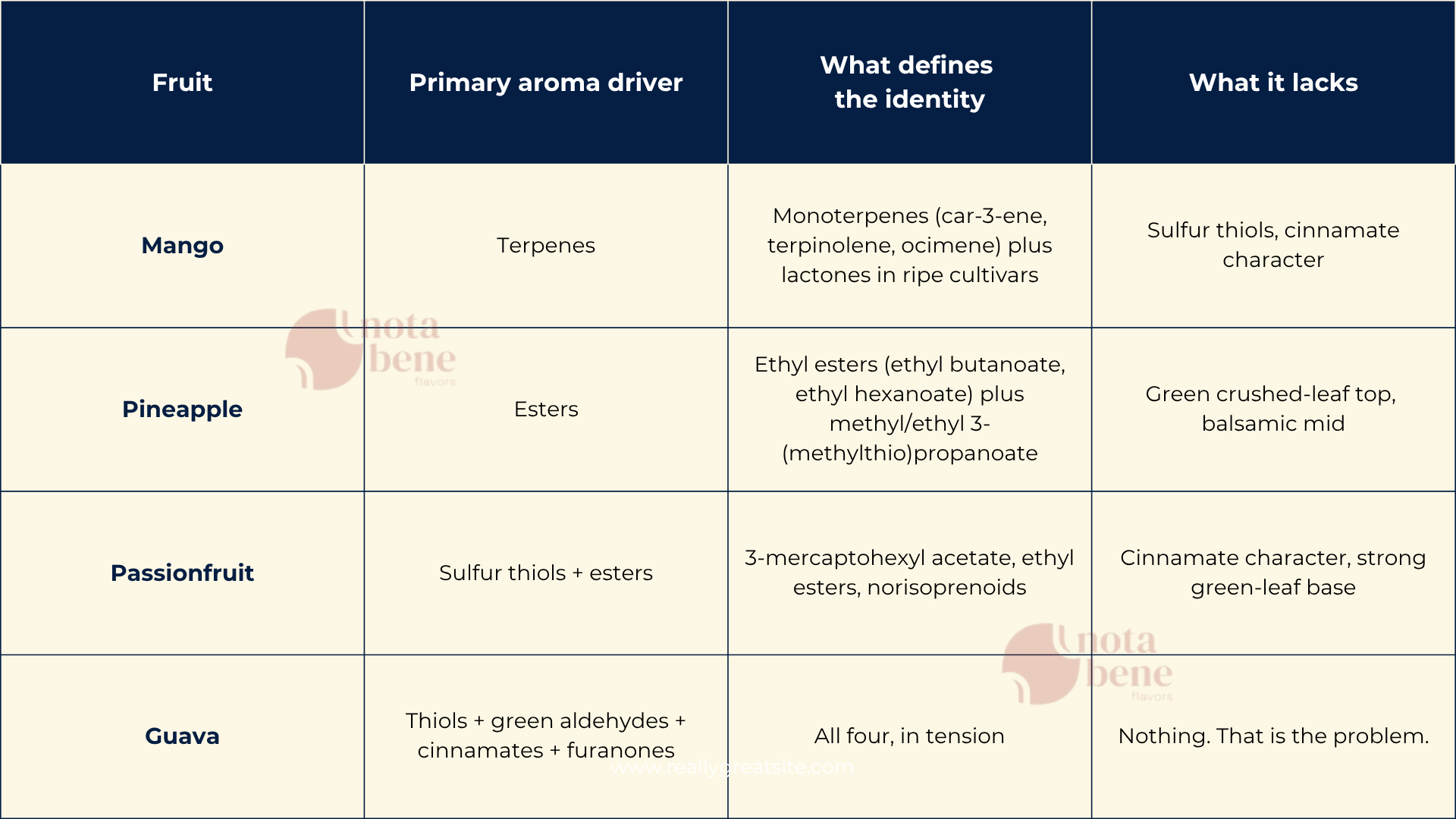
Read that bottom row carefully, because it is the whole edition in one line. Mango is a terpene fruit. Pineapple is an ester fruit. Passionfruit is a thiol-and-ester fruit. Guava is a thiol fruit and a green fruit and a cinnamate fruit and a furanone fruit, simultaneously.
Guava and passionfruit are the closest sensory relatives on this list, though they are not botanically related. Their similarity comes from shared volatile thiols. This is why lower-quality guava flavors often drift toward a passionfruit profile, as the underlying thiol structure is fundamentally similar. What separates them is everything around that core structure. Guava carries a heavier green-leaf top note and a cinnamate-balsamic midsection that passionfruit does not, while passionfruit leans much more heavily on norisoprenoid and ester-driven notes that guava does not emphasize to the same degree.
This is also why you cannot build guava by reaching for a single character-impact compound. Mango has a usable “mango” terpene signature. Pineapple has ethyl esters that can give you pineapple almost on their own. Guava has no single molecule that says “guava.” It is an architecture, not an ingredient.
Four Myths Worth Killing
Myth 1: Guava is just a sweeter, pinker tropical blend. This is the myth that produces most failed guava submissions. Guava is not mango plus pineapple plus pink. Its identity lives in compounds that mango and pineapple do not produce in meaningful amounts. You can blend tropical fruits all day and never arrive at guava, because the thiols, the cinnamates, and the crushed-leaf green are not in the parts you are blending.
Myth 2: The green note in guava is in the fruit. It mostly is not. The signature green, grassy top note of guava comes largely from (Z)-3-hexenal, and that compound is “hardly present in intact fruits but formed very quickly during crushing” (Steinhaus et al. 2009). The enzymes that make it only fire once the tissue is damaged. This has a direct formulation consequence: the green character you are chasing is a fresh-cut artifact, not a stored one, which is why it is the first thing to disappear in any processed guava product and the first thing you have to rebuild.
Myth 3: Natural guava flavor is the easy version. It is the harder version. The molecules that define guava identity, the volatile thiols especially, are among the most potent and most fragile aroma compounds in the entire flavor toolbox. They oxidize, they bind to metals, and they sit at threshold levels measured in nanograms per liter. A natural guava that has to survive pasteurization and six months on a shelf is one of the more demanding briefs in the fruit category, not one of the easier ones.
Myth 4: If it tastes “off” or “savory,” you added too much sulfur. Sometimes. But guava is, when formulated correctly, a little savory. Methional, the cooked-potato compound, is one of the omission-confirmed key aroma compounds of pink guava (Steinhaus et al. 2009). A trace of savory-sulfury character is part of the ripe-fruit signal. The error is usually not that the sulfur is present, it is that the green and balsamic layers are too thin to balance it.
