

The Terpene Gap
What 60 Years of Flavor Chemistry Actually Tells Us

Every time I post about a terpene on LinkedIn, the same thing happens.
I’ll share data on β-myrcene. Usage rates, odor thresholds, formulation behavior. Standard flavor chemistry. Within hours, someone from the cannabis industry appears in my comments. “What about the entourage effect?” “Myrcene is sedating.” “Limonene is anxiolytic.” “Terpenes modulate THC activity.”
I’m a flavor chemist. I’ve formulated with terpenes for nearly 15 years. Citrus oils, hop extracts, botanical blends, fruit profiles. Terpenes are some of the most fascinating and commercially important molecules I work with every day.
So I did what any scientist would do. I went and read the peer-reviewed literature on the cannabis entourage effect. The foundational papers. The receptor binding studies. The animal models. The single human trial.
What I found was a hypothesis that has been marketed as established science, built on evidence that wouldn’t survive a first-year pharmacology seminar. But the real story is more interesting than that. Because what the flavor and fragrance industry knows about terpenes, after six decades of rigorous characterization, is extraordinary. And it has nothing to do with cannabinoid receptors.
The Entourage Effect Origin Story
The term “entourage effect” first appeared in a 1998 paper by Ben-Shabat and Mechoulam. It described how endogenous lipids (compounds your body produces naturally) could modulate the activity of endocannabinoids at their receptors. The paper had nothing to do with cannabis terpenes. It was about fatty acid glycerol esters.
Thirteen years later, Ethan Russo published a narrative review in the British Journal of Pharmacology titled “Taming THC.” This is the paper that launched the modern entourage effect as the cannabis industry understands it. Russo proposed that cannabis terpenes like myrcene, limonene, and linalool could pharmacologically interact with THC and CBD to produce different therapeutic effects.
Here is what Russo’s paper did not include: original experimental data. It was a literature review. It proposed mechanisms. It cited preclinical studies on individual terpenes (most conducted at doses far above anything relevant to cannabis consumption). It speculated about synergies. It tested nothing.
The cannabis industry took this speculative framework and turned it into product claims. Dispensary menus now list terpene profiles alongside effects: myrcene for relaxation, limonene for mood elevation, linalool for anxiety relief. The indica/sativa classification system (which Watts et al. demonstrated in 2022 in Nature Plants is genetically meaningless, since labeled samples are genetically indistinct on a genome-wide scale) was repackaged as a terpene story.
The marketing ran ahead of the science by about a decade. And it never came back.
To be clear, this is not a critique of cannabis research broadly. Cannabinoid pharmacology is a legitimate field with real clinical findings. CBD modulation of THC has stronger supporting evidence, and Pamplona’s 2018 epilepsy meta-analysis showing whole-plant extracts outperforming CBD isolates is worth investigating further. But that finding likely reflects minor cannabinoid interactions, not terpenes. The distinction matters.
The Evidence Scorecard
For the entourage effect to work the way the cannabis industry claims, terpenes would need to do one of two things at concentrations present in cannabis products: bind to cannabinoid receptors directly, or modulate how THC and CBD interact with those receptors.
Four independent research groups tested this. Their findings were consistent.
Santiago et al. (2019) tested six common cannabis terpenes at CB1 and CB2 receptors using radioligand binding assays. No activity detected. Finlay et al. (2020) repeated the test using both binding and functional assays (cAMP pathway). No activity. Heblinski et al. (2020) expanded the receptor panel to include TRPA1 and TRPV1, two ion channels often cited as alternative terpene targets. No activity at concentrations up to 100 μM. Dvorakova et al. (2022) tested terpenes at neuronal CB1 receptors. Little to no effect.
Four labs. Multiple receptor systems. Multiple assay methods. The same result: terpenes at pharmacologically relevant concentrations do not activate or modulate cannabinoid receptors.
Two studies reported positive findings. Both have significant caveats.
LaVigne et al. (2021) injected mice with terpenes and measured pain behavior. They found analgesic effects. But the doses were 200 mg/kg administered intraperitoneally. For a 70 kg human, that scales to approximately 14,000 mg of pure terpene injected directly into the abdomen. This is not a dose anyone encounters from smoking or eating cannabis.
Raz et al. (2023) reported terpene activation of CB1 receptors using Xenopus oocyte electrophysiology. The finding contradicts Santiago et al., who used similar receptor systems. Four of the eight authors were employed by Bazelet, an Israeli cannabis manufacturer. The study has not been independently replicated.
The only controlled human trial was Spindle et al. (2024) from Johns Hopkins. Twenty participants vaporized d-limonene alongside THC. At the highest dose (15 mg pure vaporized limonene), participants reported reduced anxiety. Lower doses (1 mg, 5 mg) showed no effect. The study was not aroma-blinded, only 12 participants completed the key session, and co-author Ethan Russo holds a patent application for combining limonene with THC and founded CReDo Science, a company that develops terpene-cannabinoid formulations.
Here is the evidence, summarized:
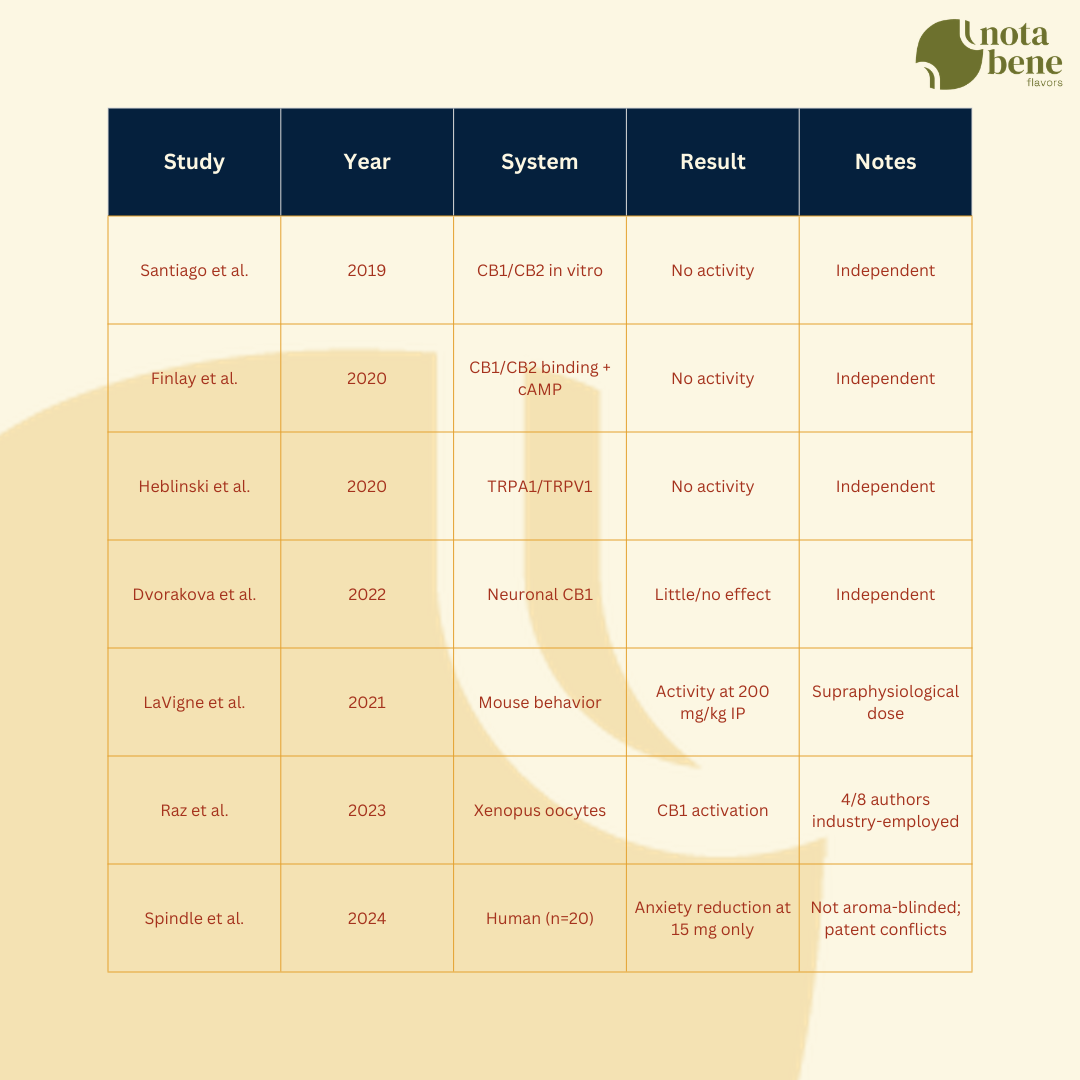
Christensen et al. (2023) reviewed the full body of evidence and called it “contradictory, equivocal, inconclusive,” and possibly “borderline pseudoscience.” André et al. (2024) conducted a PRISMA systematic review and concluded the hypothesis “remains unproven.”
The Dose Gap That Breaks Everything
This is where my work as a flavor chemist becomes directly relevant.
Cannabis flower contains 1-3% total terpenes by dry weight. In a typical smoking or vaping session with 0.5 g of flower, you are exposed to roughly 5-10 mg of total terpenes before accounting for combustion losses, incomplete vaporization, and first-pass metabolism.
The animal studies that showed terpene bioactivity used doses of 50-200 mg/kg. For a 70 kg adult, that translates to 3,500-14,000 mg of pure terpene. The gap between what a cannabis consumer actually encounters and what produced effects in a rodent model is 700 to 1,400 times.
To put this in food-industry terms:
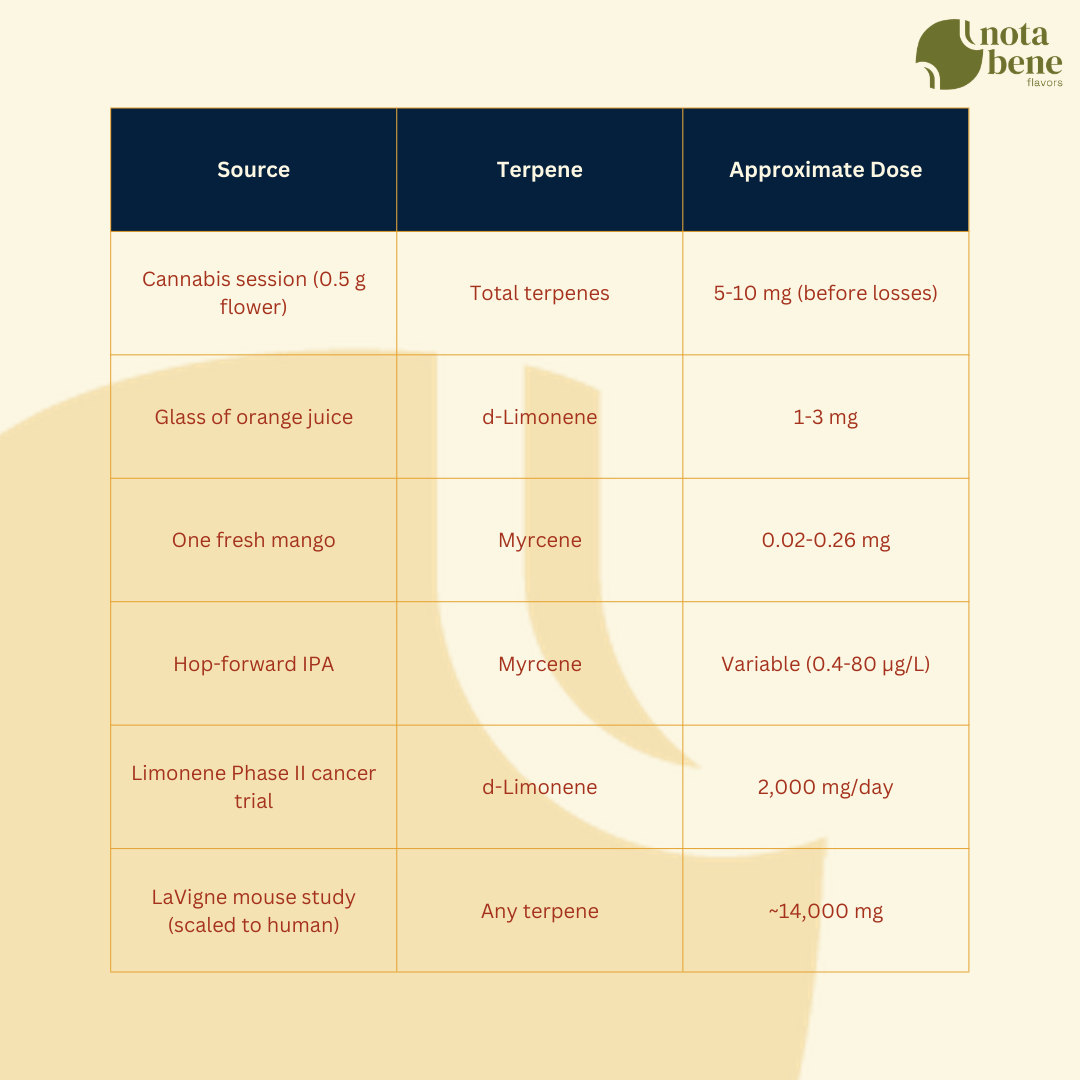
Orange juice delivers a comparable dose of d-limonene to a cannabis session. If limonene were anxiolytic at these concentrations, every person who has ever peeled an orange or drunk a glass of Tropicana would know. Mango contains myrcene. If myrcene were sedating at dietary exposure levels, every mango farmer on earth would be asleep.
The pharmacokinetics make the gap even wider. Monoterpenes are rapidly metabolized and eliminated after oral administration. Papada et al. (2020) demonstrated that myrcene is absorbed into human plasma (Cmax ~900 µg/L from an ~85 mg dose), but formal absolute oral bioavailability has never been determined for myrcene in any species. For α-pinene, Falk et al. (1990) calculated total blood clearance of ~1.1 L/h/kg from inhalation data, suggesting high hepatic extraction and oral bioavailability likely in the range of 5-20%. No direct oral bioavailability measurement exists for α-pinene either. A cannabis consumer would need to consume orders of magnitude more terpene than any realistic consumption scenario provides to approach the doses that showed activity in animal models.
The dose makes the poison. It also makes the medicine. At the concentrations present in cannabis products, terpenes are sensory molecules. The data is clear on this.
