

Vanilla Extract Part 1
History, Chemistry, and Origins

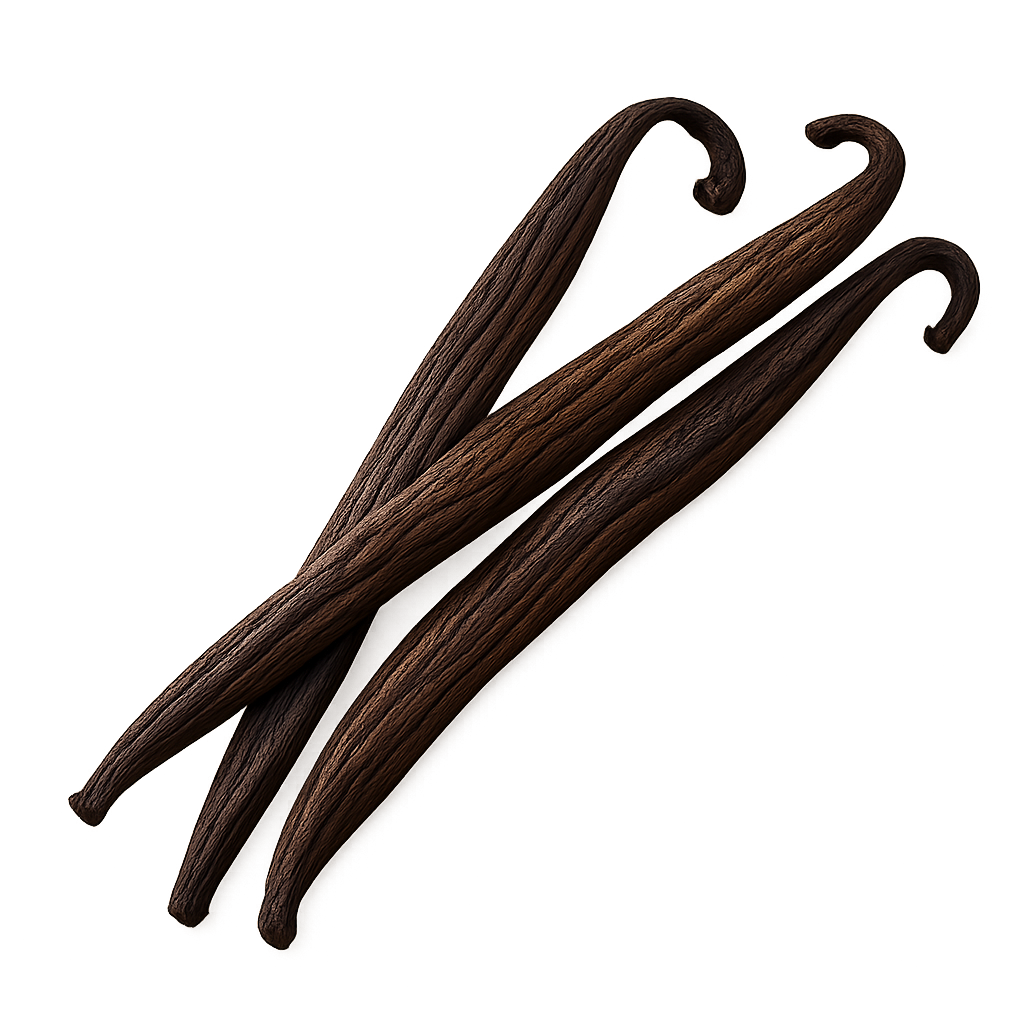
The Two Innovations That Created Modern Vanilla
In 1841, a 12-year-old enslaved boy on the French colony of Réunion solved a problem that had stumped botanists for decades.
His name was Edmond Albius. And his discovery would break Mexico’s 300-year monopoly on vanilla and create what is now a $3.6 billion global industry.
The problem was pollination.
Vanilla orchids (Vanilla planifolia) possess an elegant anatomical trap: a thin membrane called the rostellum physically separates the male anther from the female stigma, preventing self-pollination. In Mexico, specialized bees evolved to breach this barrier. But when European colonizers brought vanilla cuttings to their tropical colonies (Réunion, Madagascar, Java) the vines flourished but produced no beans.
Ferréol Bellier-Beaumont, a plantation owner and passionate botanist on Réunion, owned a vine that had grown for 20 years without yielding a single pod.
One morning in late 1841, Ferréol found two green vanilla pods on his barren vine. When young Edmond (who worked alongside Ferréol learning botany) claimed responsibility, Ferréol was incredulous. But Edmond demonstrated his technique: using a thin bamboo splinter, he lifted the rostellum membrane, then pressed the anther against the stigma with his thumb. The gesture took seconds.
The French call it “le geste d’Edmond” (Edmond’s gesture).
The technique spread across Réunion within months. Albius was sent to plantations throughout the island to teach enslaved workers the method. Production exploded: from 38 kg in 1846 to 200+ tonnes by 1898. Madagascar received cuttings and the technique in the 1840s-1870s. By the 1920s, Madagascar had become the world’s dominant producer.
Edmond Albius received no compensation for his discovery. He died in poverty in 1880 at age 51, in a hospital in Sainte-Suzanne.
His hand-pollination technique (unchanged since 1841) is still used for 100% of commercial vanilla production worldwide.
But Albius’s breakthrough solved only the first problem: how to grow vanilla commercially outside Mexico. It didn’t solve the second problem: how to use it consistently in manufacturing.
Six years later, in 1847, a Boston chemist named Joseph Burnett did something equally revolutionary: he extracted vanilla beans in alcohol.
Not to cut costs. Not to adulterate. But to solve a real formulation problem.
Vanilla beans were wildly inconsistent. One batch might contain 2.5% vanillin. The next might contain 1.2%. Bakers and confectioners had no way to standardize dosing. A cake recipe that worked perfectly with one batch of beans would taste completely different with the next. The beans themselves were difficult to process: tough, fibrous, nearly impossible to grind uniformly.
Burnett’s insight was direct: dissolve the flavor compounds in ethanol. Filter out the solids. Age it for consistency.
Suddenly, vanilla became a standardized ingredient. Manufacturers could specify “2 oz vanilla extract per batch” and get predictable results. The alcohol acted as both solvent and preservative. The extraction transferred the vanillin, phenolic compounds, and volatile esters while leaving behind the insoluble plant fibers.
By 1938, the FDA formalized the standard: vanilla extract must contain 13.35 oz vanilla beans per gallon and minimum 35% alcohol.
179 years later, vanilla extract remains the primary delivery vehicle for vanilla flavor in commercial food manufacturing.
These two innovations (Albius’s hand pollination and Burnett’s alcohol extraction) created the modern vanilla industry. But here’s what most formulators don’t understand: vanilla extract isn’t a commodity ingredient. Madagascar extract, Tahitian extract, and Indonesian extract have fundamentally different aromatic profiles. Single-fold, two-fold, and ten-fold extracts aren’t just concentration differences; they’re formulation tools for different applications.
And treating “vanilla extract” as interchangeable leads to batch-to-batch variation when suppliers switch origins due to supply constraints.
The chemistry matters. The origin matters. The extraction method matters.
This is what you need to know.
What’s Actually In a Cured Vanilla Bean (Before Extraction)
Before we understand what extraction does, we need to understand what’s in the bean.
A properly cured Vanilla planifolia bean contains over 200 volatile compounds. But the dominant compounds vary dramatically by origin.
Madagascar (Bourbon) vanilla:
Vanillin: 1.7-2.5% dry weight
p-Hydroxybenzaldehyde: ~0.5% (second most abundant phenolic)
Vanillic acid: 0.1-0.2% (chocolate, creamy notes)
Guaiacol: ~9.3 ppm (smoky, phenolic depth)
4-Methylguaiacol (creosol): ~3.8 ppm (woody warmth)
Supporting aldehydes, alcohols, esters
The sensory profile: sweet, creamy, smooth, with balsamic undertones and subtle spicy notes. This is the industry benchmark.
Tahitian vanilla (V. x tahitensis):
Vanillin: 0.5-1.5% dry weight (significantly lower)
Anisyl alcohol: ~30% of total aromatics (vs 0.05% in planifolia)
p-Anisaldehyde: primary aroma contributor (cherry, almond, anise notes)
Anisic acid: ~15% of total aromatics
Anisyl acetate, methyl anisate: supporting fruity-floral compounds
Total anisyl compounds represent 70% of volatile content in tahitensis versus only 7% in planifolia.
The sensory profile: floral, fruity, with pronounced anise and caramel notes. Not “stronger vanilla.” It’s a different flavor system entirely.
Indonesian vanilla:
Vanillin: 1.21-3.50% (wide range depending on variety and curing quality)
Notable guaiacol and phenolic content (though not definitively higher than other origins; comparative data is limited)
Supporting woody, smoky compounds from curing variations
The sensory profile: smoky, woody, with earthy undertones.
Mexican vanilla:
Vanillin: 0.75-2.5% depending on grade
Distinct curing method (sun-wilting vs. hot water scalding) produces different phenolic profile
Trace eugenol contributes spicy character
The sensory profile: smooth, spicy, woody with subtle smoky notes.
Ugandan vanilla:
Vanillin: 1.6-2.5% typical; premium Grade A reaches 2.9%
Higher total volatile concentration (398 mg/kg vs Madagascar’s 301 mg/kg)
Elevated 3-hydroxy-4,5-dimethyl-2(5H)-furanone (HDMF/Furaneol, FEMA# 3174) (caramel, maple notes)
The sensory profile: bold, chocolatey, cocoa-rich with dried fruit notes.
In addition to these volatile compounds, cured beans contain glucovanillin (unreacted precursor, 0.5-2% remaining after curing), moisture (20-30% in cured beans), and lipids, waxes, and cellulose (structural plant material).
The extraction process must selectively transfer the flavor-active compounds while leaving behind the insoluble matrix.
